Monday, August 27, 2012

A tour of new architecture in Orestad Syd

We having been dragging friends and family to see the 8 House and other notable building projects in the new city of Orestad for a few years now. But on Sunday, we went on a tour professionally-led by the Danish Architecture Center of the city's southern section, and now have some more info to match our amazement (http://www.dac.dk/da/service-sider/kalender/).

Tour group under Metro in Orestad with Ramboll building in background
The city has roots going back to the 1930s, when talk first began creating a rail-link between Copenhagen and southern Sweden, and the implications that would have for development in the Kastrup/ Amager Faelled area south of the city. By the time the Oresund Bro linking Denmark and Sweden opened in 2000 (http://uk.oresundsbron.com/page/976), metro lines and city plans for Orestad were already in place on a former military site. A Finnish-Danish design group was selected and established a plan which included mixed educational, commercial, housing and cultural sites in a series of bands moving out from the metro line and incorporating three new urban centers. Green building practices were an important standard and all buildings were to be 600 meters or less from a metro entrance.

After a much longer and better explanation of the larger plan than the one I just gave, out tour group moved on to the front of the corporate headquarters of Ramboll - a firm that was very much involved with building the Oresundbro and other large engineering projects in Scandinavia.
Mirrored sky on the facade of the Ramboll building, Orestad
As it was a Sunday morning, the building was closed and we had to peek into the soaring lobby through glass doors. The tour guide informed us that on weekdays all the buildings in the area were open to the public and generally receptive to visitors.

Next up was Copenhagen Towers, which is just across the street. So far just Phase I of the four phases this project, designed by Norman Foster and Danish partners, has been built. This phase constitutes the Crowne Plaza Hotel Copenhagen Towers, which has been distinguished as the greenest hotel in the world. Among other features, the south and western sides are lined with solar panels, they utilize ground water versus geothermal systems for air-heating and cooling, the shampoo containers are biodegradable within three months, and guests can give back to the grid when they spin on one of the bikes in the fitness center. Apparently this is one of the buildings that is particularly receptive to visitors, as they have a Walk of Sustainability throughout the building with QR codes directing you to info about their sustainability practices.
Crowne Plaza Hotel Copenhagen Towers lined with solar panels
The next stop for the group was in the middle of a field, buzzing with late summer yellow-jackets, where Denmark's largest multi-use stadium complex would be standing by 2015.
Future site of Hannemann's Quarter and Arena, with Orestad city in the backgorund
Our guide distributed maps which outlined all the development planned for this area over the next several years, including housing, schools, businesses, sports fields and a gigantic arena complex linked to the Metro lines and trains to Sweden. Thus far, only the Phase I of Copenhagen Towers, on the upper right of the map (left of the metro line) had been built.
Plan for development of Orestad Syd
We continued southward on a path through the field till we hit the "Plug n Play" - a temporary playground of sorts designed to attract foot traffic and buzz to this as-yet fully-developed area of Orestad. The Plug 'n Play has an outdoor skating oval and skateboard park, parcours park, all manner of climbing equipment, a kayak bay with water polo, as well as more traditional basketball and soccer areas. Families were unloading kids and equipment while the guide explained all this, so apparently the idea is working.
Entrance to Plug n Play Zone in Orestad Syd
Surrounding this amazing play zone were a number of small garden plots. Anyone can reserve one for a nominal fee, as long as they commit to working it and to abide to organic gardening standards.

Organic garden plots in Orestad Syd
Soon enough we had reached the southernmost point of the development, where seniors' and student housing is going up alongside multilevel parking lots. In keeping with the green standards throughout, the parking spaces planned for this area are at half the normal proportion of slots to other areas of the city. The hope is that most residents will find it more convenient to take the Metro or bike than deal with carrying bags out of a multilevel garage. But I did notice there was 30-minute parking alongside most of the established housing and a surface lot behind the 8 House.
Interior courtyard of the 8 House looking south across the marshes
Which brings us to the 8 House and one of our favorite spots in all of Copenhagen. We came across it the first time in a bike ride around Amager Faelled when it was just going it up. It looked like a ski slope or that horrid Xanadu complex in the Meadowlands of New Jersey. Later on, we found the vimeo featuring architect Bjarke Ingels ( BIG Group) describing the project and how it was conceived: http://vimeo.com/3499612.  And if we ever win the lottery, we will have to buy a unit there.

I won't bore you with my praises here. Just watch the vimeo, look at the few photos I have included and take a chance to visit when you are next in Copenhagen.

View of Viking Ship playground and marshes from atop of the 8 House
Green roofs at southern end of 8 House
Looking into the north courtyard of the 8 House.


Thursday, August 23, 2012

The lovely island of Hven


When I showed an American friend this poster for the ferry to Hven, she remarked "Ah, Heaven!" That may be overselling it a tad, but it is a very lovely spot and an excellent day-trip out of Copenhagen. Hven lies in the narrow Oresund strait between Denmark and Sweden, and has at times been Danish, but now is Swedish (see visithven.dk).

Boarding at Havnegade; some folks brought bikes and picnic lunches
We took a 9:15 ferry from Havnegade for the 90 minute trip with about 150 others - mostly Scandinavians. We bought rundstykker and coffee once on board, all the better to enjoy our little table looking out at the sights of Copenhagen harbor, the Oresund bridge, and the coastline north of the city while we motored along.

Oresundbro to Malmo and windfarms seen from the ferry
Once landed, we followed the crowd up a small road to an enormous bike rental stand with every possible combination of regular and tandem bikes, bikes with kid seats and cargo bikes. There was a bus offering a tour at the harbor, but I don't think anyone took it. This was a hearty lot of Danes and Swedish tourists and the exercise was definitely part of the outing, as it was for us. We had decided beforehand to spend the day walking the 11.7 km along the edge of the island, and ended up backtracking down to the Bagvicken harbor to catch the walking trail.

Bike rental stand on Hven
We started walking east, or counter-clockwise, around the island along the coast facing the Swedish mainland. This part of Hven really reminded me of Maine, specifically of Peak's Island in Casco Bay - home to our friend Jenny Higgins and one of the stops on our honeymoon 25 years ago. Needless to say, the coast was a bit rugged and had lots of long wooden piers for bathing. There were cottages alongside the path overlooking the shoreline, with well-kept gardens and cozy picnic tables.
Cottage with hydrangeas on Swedish side of Hven
About midway along this shoreline, we hit Ven's Stugby & Camping - a collection of hytte ( sleeping huts) and camping spots with a common bath area and kitchen. Some families had obviously come over on the ferry with bedding and food all piled up on a trailer and hitched it to a rental bike. Car-free family vacation!
Ven's Stugby and mini-golf ( not a real astronaut)
At the northern end of the island, where the cliffs were steepest and the shoreline rockiest, the path jigged left up a steep gravelly incline. This is where the walking decision paid off as many visitors were struggling both up and down the scrabbly path with their bikes. When we emerged at the top, we were in a gorgeous yellow wheat field - rippling in the wind - with low-lying barns on the horizon. The Swedish-ness of the terrain flipped into a classic Danish landscape and for the second half of the day, and from there on in, the dial pretty much stayed on the Danish side of the terrain and architecture.
Danish husband on Danish side of Hven
At the center of the island are the archaeological remains of astronomer Tycho Brahe's Uranienborg castle and observatory, as well as a Renaissance garden. There is a museum which explains his life and work housed in a beautiful old church, which is the highest point on the island. For a few decades in the middle of the 16th century, Hven was Brahe's fiefdom and he ran a full-scale observatory and entertained intellegentsia from across Europe on this little island. King Christian VI (who did so much to advance Denmark in other ways) undid this arrangement early in his reign, and Brahe removed to Prague and eventually met Kepler...so maybe it was OK in the long run.

Tycho Brahe Museum and garden
At any rate, an interesting historic angle on an island that was well worth visiting even without it.


Tuesday, August 14, 2012

What's so great about restaurants in Copenhagen

There has been an incredible amount written in the past few years about the new Nordic cuisine, and the restaurant scene in Copenhagen - famously led by NOMA, voted the world's best restaurant for the past three years. We have not yet eaten at NOMA, but have now had a substantial number of outstanding dining experiences in Copenhagen, and I can tell there's more going on than just foraged food. Like the characteristically great Danish design in furniture, household objects and architecture, the greatness in the "new" food comes from a certain elegant minimalism, attention to detail and a respect for the importance of tradition.

A classic Georg Jensen silver water pitcher, for example, grows out of the basic function of the vehicle and  elegantly marries the swell of the water vessel and the angle of the spout with a comfortable handle for the pourer. There is no mistaking what this object is designed to do, but great attention is also paid to the small details. The handle is mahogany, so you are holding a warm organic material and not cold metal. If I had found a better photo of the pitcher, you'd see that the surface is softened by hand-hammering, so you know it is a handmade object. And the beauty of the object respects the fact that serving food and water is an important party of family, and thus community, life -- so it is always worth doing very well. ( Sorry if this analogy ran on a bit long. Hard to put away the art historian in me sometimes).
Danish silver pitcher designed by Johan Rohde for Georg Jensen, Ltd.


The great new restaurants in Copenhagen observe a certain elegant minimalism that is quintessentially Danish. A green salad, or a piece of fish, or a poached egg is prepared and presented in such a way as to bring out the essential flavor of lettuce, or fish or eggs. That isn't to say, that other interesting ingredients aren't a part of this "unveiling" of taste, but they help to pump the flavor and don't get in the way.

Just a few days ago, I told my sceptical daughter that mushrooms take on the flavor of whatever they are cooked in - butter, or wine, or herbs and cream - so she couldn't declare a dislike for them. But the mushroom soup at Geist, http://restaurantgeist.dk/, made me a liar. A clear consomme served in a black bowl without a spoon (" so you put your face right into the smell") was the absolute soul of mushroom flavor in liquid form - earthy and dark.

Also at Geist, we tasted the unusual dish of sauteed almonds with caviar- a stunning plate of pale ovals set off with a teaspoon of shiny black caviar. Each ingredient held its own simple taste and "mouth feel," but you noticed it more through the combination.

At the beautiful Orangeriet, http://www.restaurant-orangeriet.dk/, which is housed in an old greenhouse within the walls of Kongens Have, we ordered a cold tomato and crab soup as a first course. I was expecting something in the gazpacho line, but instead was presented with a  bowl containing three dollops of crabmeat garnished with slices of green tomatoes, elderberries and a few sprigs of herb alongside a small vial of clear golden liquid - the tomato broth. The broth was fresh and understated as ripe tomato flesh, without the oily heaviness of  a typically Italian red tomato sauce. The crab just tasted more of the sea-shore for the light tomato essence.

The devil is in the details. And it is not just the food which is remarkable in the interesting new restaurants here. At Relae,http://restaurant-relae.dk, the tables have a narrow drawer full of utensils and napkins so diners can shift their own cutlery. At Geist, you can choose to sit at a bar overlooking the finishing kitchen so your meal is handed to you almost directly off the stove. You can watch the rhythm of the prep cooks, identify which dish is yours, and it doesn;t need to walk through a set of doors and around tables in a restaurant before you get to eat it. Both shifts in service make sense from the management side, and lend to the informality of the experience.

Relae, and its sibling restaurant Manfreds & Vin, are both on Jaegersborggade, an artsy one-way street in Norrebro that leads right into the incredible Assistens Cemetery (a whole 'nother topic). And both restaurants feature translucent porcelain table votives ("thinware") by neighborhood ceramicist Inge Vincents ( http://vincents@dk). May seem like a small thing, but using locally sourced artwork on your table is right up there with locally sourced produce in my book. (Organic and local is a given in most of these restaurants, BTW, not even worth mentioning out loud) And Vincents' ceramics perfectly capture the character of the food - minimal, elegant, innovative and extremely honest.

As for tradition, many of the dishes that are being served in Copenhagen are interesting twists on centuries-old Scandinavian dishes. No French fillips, or startling Thai spices - but respect for the foods and the food combinations that have always been important in this corner of the world. At Orangeriet, we had bread-fried mackerel that was a perfect nod to the oldest and most basic fare imaginable in Nordic regions - mackerel on bread. Except that Orangeriet smeared the fresh mackerel with rye bread dough on one side and then pan-fried it - so the fish and the bread were cooked into each other.

At Kodbyens Fiskebar, http://fiskebaren.dk/, the most classic combo imaginable - fishroe, onion and potato - were given an amazingly delicious and almost painterly re-make with teeny tiny chopped red onion and chive, dollops of creme fraiche, a bouquet of mixed greens and shoots and a see-through thin oblong of crispy potato (an artisanal potato chip). Other dishes were similar remixes - gorgeous thin-sliced laks, sauteed scallops, cod - all the things you'd expect on a Scandinavian table, but creatively dressed and presented with beautiful sprigs of greenery that you might find in a Danish field, and that carry the same freshness.

For all the buzz in the States and elsewhere about the new Nordic cuisine, I think it is going to be hard for it to travel well as it is so engrained in the character, workmanship and traditions of Scandinavian culture. But should be fun to watch others try.


Monday, July 30, 2012

Creeping Danishness 2.1 - How to cut food properly

So again, I am using a decimal system, because this subject may seem small, but actually it touches on two essentially Danish characteristics - precision in all things and a high value placed on thrift - so it will probably come up again.

I learned about the seriousness accorded (by Danes) to cutting food properly about 15 years ago, as part of the preparations for a family party. A group of the women were prepping in the kitchen of the town Forsamlingshuset ( most towns in DK have a communal gathering house with a full kitchen, tables, chairs, etc. for big parties), and a well-meaning cousin asked me to cut the tomatoes as pynt for the smorrebrod (decoration and things to set on top of open sandwiches). I started working away and she quickly stopped me - aghast that I was cutting the tomatoes into slices instead of wedges, or boats! She then very patiently (and I thought a bit smugly) demonstrated the proper way to cut, and display, the boats on a platter.

Tomato boats
Now I can appreciate a traditional presentation, but as an American, I am used to a certain relaxed standard when it comes to cutting vegetables. In addition to slices and boats, I have even diced the occasional tomato for a salad or for pynt. And I kinda thought that a slice of tomato would sit nice and flat on an open sandwich. But over here, it just doesn't work that way. And there is a certain method to this seemingly ridiculous orthodoxy.
Smorrebrod med pynt
Danish tomatoes are smaller than American tomatoes - especially New Jersey beefsteak tomatoes - and are rarely larger than a  baseball. This size doesn't get you a lot of slices, and then the top and bottom are wasted, too. But with boats, you just need to trim off the little green bud at the top and the rest cuts up perfectly. Precision, and thrift. The Swedes have a word that sounds like largum (but I don;t know how to spell it) and it accords to this very concept - just right. Not too much, not too little, nice to look at, works perfectly.

Now that we are here full-time, the tomato boat issue is cropping up everywhere - with cheese, and certain standard types of bread and rolls.

The delicious, kinda smelly, semi-soft cheese we love to eat here can only by cut with the wire-type of cheese slicer. But first you have to cut away a small amount of the wax around the sides, but not too much, because you need the wax to keep your fingers off the stinky cheese. Then the slice has to be thin and flat - no gulleys in the middle! -  across or you will be accused of "holing" the cheese, or udhuler. This is actually the word for not cutting the cheese properly.

Smelly cheese with the beginnings of udhule  on the left
And rygbrod, the dense rye and grain bread that is a staple for both breakfast and open sandwiches, must also be absolutely thin and flat - no artsy slants! - or your Danish husband may ridicule you. I always thought the bread slicing machine on my  mother-in-law's counter took up an absurd amount of space for its limited function. But clearly, she couldn't take the pressure of bread-slicing perfection.
Rygbrod  with one good slice and one corrective slice
Lastly, I will mention how to properly slice rundstykker, the roundish rolls that many Danes eat for breakfast or with morning coffee. You need to use a good long serrated knife, and saw it evenly, or a little ball of doughy bread will appear in the middle of your roll. The practice is in fact, nor dissimilar to the way I have seen older Jewish people in the US cut their bagels. They hold it in their hand and saw through it carefully, and you are sure they will cut themselves, but it always comes out perfect.

How to slice rundstykker demo

Ready-to-eat rundstykker with cheese and jam


Friday, July 27, 2012

Creeping Danish-ness 1.1 - Cycling

So there are many ways that our lives are becoming more decidedly Danish, hence the title. Cycling is just one of the ways, but clearly warrants more than one post, hence the 1.1.

We arrived on a Friday afternoon, and the VERY first thing we did on Saturday morning was to have Danish-style bike locks and kickstands installed, so we could park them anywhere and avoid hauling around chain locks. We had brought both our bikes over at some expense and considerable inconvenience (finding boxes and packing them, taking a van to the airport, having Bo's parents pick us up with a trailer, and reserving two 'seats' for the bikes on the train from Randers to Copenhagen). But it is inconceivable that we would not have bikes here. In addition to the long recreational rides we have been enjoying, we use them to get everywhere around town. So does everyone else.

And I must say, it feels great to whip through the city on the smooth, flat paths. There is a special set of lights and directionals for bikes, which are often travelling faster than the car traffic. I try to pick out a cyclist travelling at a pace I feel comfortable with and follow their moves around trucks or other obstacles. But I'm still not comfortable enough to head into town during rush hour, when the lanes are pretty packed.

Bikes near Christianborg
Believe it or not, the point of this picture was not the bikes. There just happen to be a lot of them. And although it is not fair to judge during the vacation season, there are decidedly fewer cars in the city because people are generally on bikes.
Bike counter on Norrebrogade
This much graffiti-ed and stickered over machine is a cyclist counter on one the major avenues into the city. On that morning, 1,563 cyclists had crossed the bridge on the outbound side by 9:30AM, and 2,119,221 this year. (The estimated population of greater Copenhagen is 1,935,746, as of this April.) Last night, when we crossed this point coming home, more than 18,000 others had done so as well  - and this on one of the most popular vacation weeks of the year. The section of Norrebrogade nearest the city has double-wide bike lanes and automotive traffic is limited to busses and delivery vehicles. Besides devices like the counter that raise awareness of cycling, there are also cute little footrests at some intersections with messages like "Thanks for biking!" and events where commuters on bikes are served free coffee and rolls.

The cycling-centric culture is not at all limited to Copenhagen. There is an extensive network of national bike routes - these are routes with less traffic or dedicated cykel-stier ( bike paths). Communities maintain their own network of bikepaths, sometimes along major thoroughfares, and sometimes behind and between other routes. We have designed whole vacations using these maps - purchased from the Dansk Cykelforbund
( http://www.cyklistforbundet.dk/), which has a very cool shop near Orstedsparken. The maps and related guides describe the routes and interest points along the way (castles, historic sites, bike hotels. campgrounds, toilets), and also point out major routes with good bike paths.

Last Thursday, for example, we spent the day biking on a mixture of designated routes and regular bike paths along roadways. We biked from Copenhagen up to Fredriksborg Slot in Hillerod ( site of the national history museum and one of the most spectacular castles in Europe), and came home by crossing over to another important royal castle in Fredensborg and down Kongevejen (the King's Road)  to join up with a numbered bike path into the city. The beginning and the end of this trip were definitely on important commuter paths, with wide lanes and constructed alongside (but fenced off from) major highways. But we picked up Bikeroute 31 in the morning between Farum and Hillerod, which took us through forest, some typically Danish fields and marshland, and which included considerable gravel or grass paths away from roads. Definitely scenic, but on the way home we opted for a large chunk of non-numbered bikepath along Kongevejen - which was smooth, straight and very fast. We met up with Bikeroute 50 which brought us back into the city, but not before passing through amazing beautiful rural stretches in Allerod, where we shared the paths with people on horseback. 

A few pictures from our "Castle Ride":

Frederiksborg Slot seen from its Baroque Garden
Fredensborg Slot
Bikes and helmets taking a rest


Tuesday, July 24, 2012

Asger Jorn Museum, Silkeborg

On Tuesday, July 17th,we had a lovely drive through Bjerringbro among other towns to Silkeborg, home of the painter and COBRA movement founder, Asger Jorn. It is set on a beautiful piece of land on the Gudenaa, near the Kayak Club and a pleasure garden of sorts with a bocce (sp?) ball course, playground and ice cream kiosk. I've been here before but the rest of the family had not, so it seemed a good half-day outing with lunch.

A piece I don;t remember so well from last time bowled me over on this visit - the Dubuffet ceramic mural affixed to the facade of the museum.
Dubuffet Mural at Jorn Museum

Entrance Jorn Museum


While Asger Jorn is not my favorite Danish artist, he did work in an impressive range of media and did hang with some of the greats - Leger, Dubuffet, Arp, Alechinsky - and they are all represented in the museum. But I think my problem with Jorn comes from knowing mostly his "master" paintings in the canon, and not the oil sketches, and prints, ceramics, and tapestries that I loved seeing in Silkeborg. I should remember that when looking at other artists that I have decided about years ago - to look more closely at their "secondary" work.

And, of course, no matter what's on the walls, every Danish museum is beautifully presented and furnished. The Jorn Museum also had gorgeous wooden block flooring.
Painting gallery in Jorn Museum
Two of my favorite pieces from the visit:
Jorn oil sketch. This is small! Maybe 18 x 18"


Detail of tapestry

Tapestry commissioned by Aarhus Stadtskole ( 8  x  50 feet?)
This is a terrible photo, but the room is necessarily dark. Jorn designed and wove this in France in collaboration with Pierre Alechinsky and others. It is remarkable if you get up really close and enjoy the quality of the weaving and the freedom of the abstraction.

Monday, July 16, 2012

Two Days in Ostjylland - one rainy, one sunny

A month after the first post, and a lot has happened.

We have driven our dog 3,000 miles across America, to her new temporary home in Portland, OR; packed up a large house that we have accumulated all manner of crap in for the past 17 years; and reduced our necessary possessions to three 50-lb. suitcases, two carry-on bags, and two crated bicycles. We have been in Denmark, at Bo's parents house in the small town of Oster Bjerregrav for four days now and only one of the those days could be called sunny. From 102 degrees and muggy in NJ to 52 degrees and rainy is quite an adjustment.

On Saturday ( 6/14), we went into the nearby city of Randers, where the sculptures of Jens Galschiot are scattered throughout town (http://www.randerskunstmuseum.dk/FrontEnd.aspx?id=3035). He is a very political Danish sculptor, whose most famous piece involves an obese naked woman holding the scales of Justice riding piggyback on the shoulders of an emaciated man. Others around town depict specific homeless people from throughout the world, and allegorical groups such as this trinity in a new public square adjacent to the art museum: 
Hard to see from this shot, but on each cross is hanging a pregnant teenage girl as a protest against the Roman Catholic Church's prohibition on birth control in a world where so many unwanted children are born into dire poverty. Compelling, if rather obvious, and absolutely the LAST thing you'd see on view with the help of public funding in the US. Remarkably, there were no protesters in sight.

On a more light-hearted note, there were young street performers in another part of town hamming it up, doing head stands in broken glass, banging on drums and the like. One performer was my in-laws' next door neighbor, Caroline.
Caroline

Yesterday was the best chance of non-rain in sight, so we set off on our bikes at 8:30AM for Mariager, a scenic old town on Mariager Fjord about 16 miles form Bjerregrav. It started off well, but within an hour, dark clouds loomed and we ran into a medium rain shower. A quick change of jackets made it bearable, then absolutely doesn't-get-better-than-this perfect when the cloud passed over and we were again cycling in brilliant sunshine.
We got to Mariager by 10AM and it was deemed too short a ride for such a nice day, so Bo revisited the maps and we lengthened the ride up along Mariager Fjord and back through the farmland north of Randers where so much of Bo's family has held farms and businesses over the years.

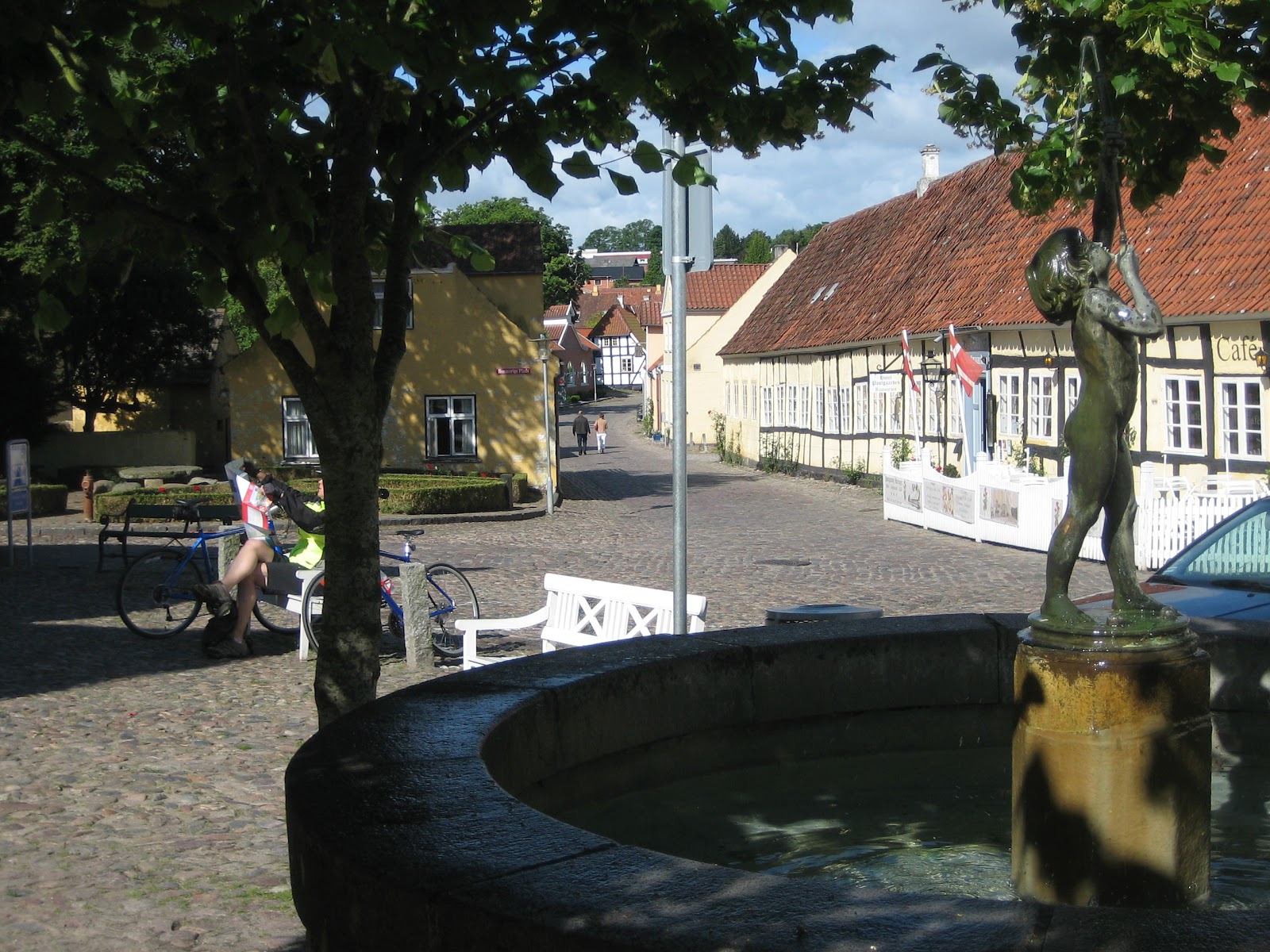
Bo consulting bike map in central square of Mariager
Andrea biking along Mariager Fjord towards Assens
Kind of a mistake....Yes, it was lovely landscape and yes, the rain held off. But we were hit with an unbelievable headwind for the last third of the 56 mile bike ride and had to pedal pretty hard to avoid being blown backward, even going downhill. We earned a beer with our very late lunch. But it was definitely a cautious tale about biking in Denmark.